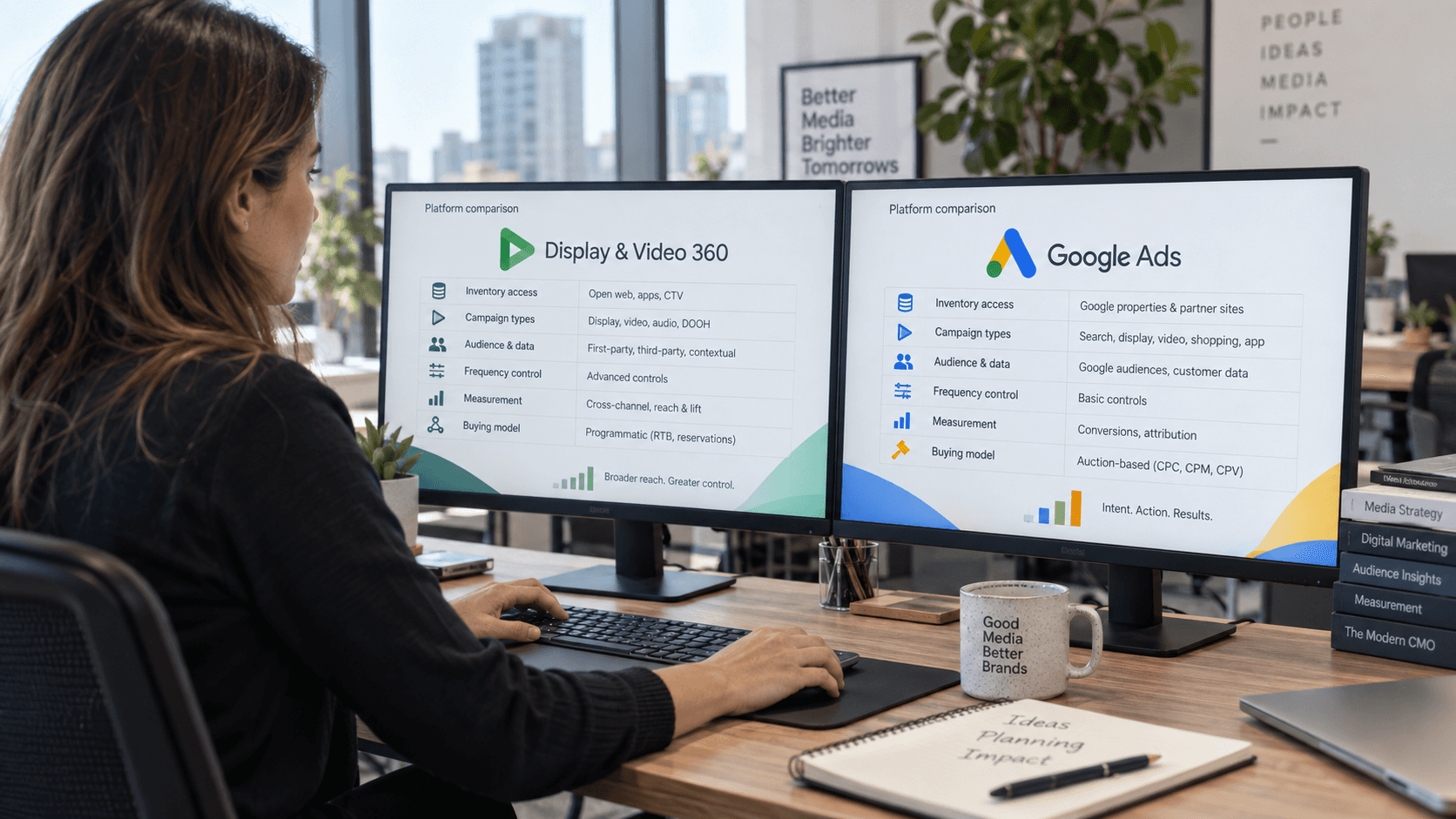

Quick answer: Google Ads is usually the better starting point for Search, Shopping, app promotion, Performance Max and conversion-focused campaigns centered on Google inventory. Display & Video 360 is designed for advertisers and agencies that need enterprise programmatic buying across multiple exchanges, private deals, Connected TV, premium video, audio, digital out-of-home and more centralized campaign governance.
Neither platform is universally better. Use Google Ads when the job is demand capture or simpler activation across Google channels. Use DV360 when the job requires broader programmatic supply, deal-based buying, enterprise controls or cross-channel planning. Many mature advertisers use both, with a clear role and measurement plan for each.
DV360 vs Google Ads decision table
If your priority is... | Start with | Why | Important caveat |
|---|---|---|---|
Search demand capture | Google Ads | Search campaigns reach people actively searching for products and services. | DV360 is not a Search campaign platform. |
Shopping and Merchant Center feeds | Google Ads | Shopping and Performance Max support product-led conversion campaigns. | DV360 can support retail media and programmatic commerce use cases, but not as a replacement for Google Shopping. |
Simple YouTube activation | Google Ads | Video campaigns are accessible inside the same account as Search and other Google campaigns. | DV360 may add value when YouTube must sit inside an enterprise video, CTV and programmatic plan. |
Multi-exchange programmatic buying | DV360 | DV360 can buy across enabled third-party exchanges and publisher deals. | Access depends on account, geography, exchange and contract. |
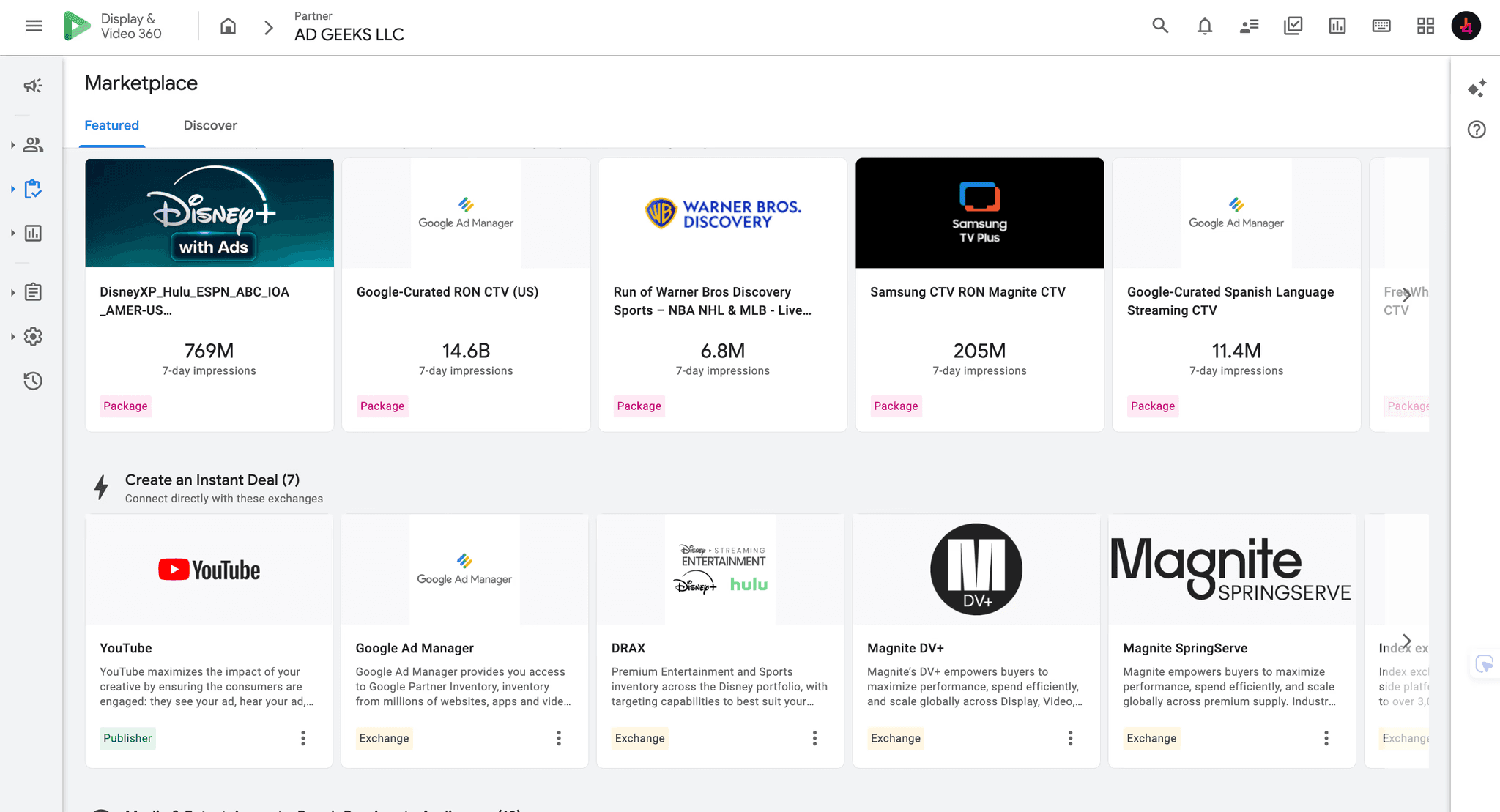
Premium CTV and private deals | DV360 | DV360 supports CTV insertion orders, CTV line items, Marketplace packages and deal workflows. | Verify the exact publishers, markets and deal paths before planning. |
Programmatic audio or DOOH | DV360 | DV360 documents dedicated audio and digital out-of-home buying workflows. | Available exchanges, targeting and measurement differ by channel and market. |
Lower-friction setup for a small team | Google Ads | Google Ads is generally easier to start directly with campaign budgets set in the account. | Operational simplicity should not replace channel fit. |
Enterprise permissions, deals and governance | DV360 | The platform is structured for partner, advertiser, campaign, insertion-order and line-item control. | More control also means more setup, training and operational responsibility. |
Simple rule: Google Ads captures intent inside Google's advertising ecosystem. DV360 manages broader programmatic media when supply, deals, governance and cross-channel control matter.
What is the difference between Google Ads and DV360?
Google Ads is Google's primary advertising platform for Search, Display, Video, App, Shopping and Performance Max campaigns. Google recommends selecting the campaign type based on the advertiser's goal, strategy and time available. It is built to make direct campaign creation and automated optimization accessible to a wide range of advertisers.
DV360 is part of Google Marketing Platform. Google positions it as an end-to-end campaign management product for enterprises, covering planning, creative, buying, measurement and optimization. It provides native YouTube buying while also connecting to partner exchanges, publisher deals and programmatic channels beyond the standard Google Ads workflow.
The overlap is real, especially in YouTube and display. The difference is the operating model. Google Ads is campaign-type and goal led. DV360 is a programmatic buying environment built around inventory sources, deals, line items, audiences, bidding, measurement and enterprise permissions.
Which platform has better inventory?
“Better” depends on the media plan. Google Ads is the required choice when Search or Shopping is the job. It also provides Display, Video, App and Performance Max inventory through Google Ads campaign types.
DV360 becomes more relevant when the plan requires third-party exchange inventory, publisher packages, private marketplace deals or Programmatic Guaranteed. Google states that DV360 can bid on or exclude impressions from dozens of partner exchanges. Its Programmatic Guaranteed workflow supports publisher proposals, targeting, consolidated reporting and billing.
Channel or buying route | Google Ads | DV360 |
|---|---|---|
Search | Core strength | Not supported as a Search campaign platform |
Shopping | Core campaign type through Shopping or Performance Max | Not a replacement for Google Shopping |
YouTube | Video campaigns | YouTube & partners line items, including enterprise planning workflows |
Open-web display and video | Google Display Network and eligible campaign inventory | Enabled third-party exchanges, packages and deals |
Connected TV | YouTube and eligible video inventory | Dedicated CTV insertion orders, CTV line items, YouTube & partners on CTV and deals |
Programmatic Guaranteed | Not the core buying workflow | Dedicated publisher proposal and deal workflow |
Programmatic audio | Limited compared with a DSP workflow | Dedicated audio line items and supported audio exchanges |
Programmatic DOOH | Not a standard campaign type | Dedicated DOOH buying and reporting workflow |
Is DV360 better for YouTube?
Both platforms can run YouTube campaigns. Google Ads is often enough for advertisers that need straightforward video reach, views or conversion activity alongside Search and other Google campaigns. DV360 is useful when YouTube must be managed inside a broader enterprise plan with third-party video, CTV, deals, centralized permissions and more detailed programmatic structures.
Do not assume the DV360 label automatically improves performance. The advantage comes from workflow, inventory strategy, audience planning, measurement and governance. If the media plan only needs a simple YouTube campaign, the additional DV360 operating layer may not be necessary.
Is DV360 better for Connected TV?
DV360 is generally the stronger operating environment when Connected TV is a major multi-publisher programmatic channel. Google documents CTV insertion orders, CTV line items for premium TV inventory, YouTube & partners on CTV and RTB buying. It also supports packages and private deal workflows.
Google Ads can still reach television screens through eligible YouTube video activity. The decision changes when the plan requires named streaming publishers, private deals, cross-publisher CTV, deal-level reporting or a combined CTV and open-web video strategy. In that case, DV360 usually deserves evaluation.
How do targeting and first-party data compare?
Google Ads is strong when targeting and optimization are connected to Google campaign goals, first-party signals and direct-response outcomes. Search keywords, Merchant Center data and app signals are especially important advantages that DV360 does not replace.
DV360 provides programmatic audience and contextual controls across eligible inventory sources and line-item types. It can also connect with wider Google Marketing Platform workflows. The exact audience options vary by geography, inventory, account permissions and policy.
Start with the data question:
Is the audience defined by search intent, product feed behavior or app activity?
Does the campaign need first-party lists across multiple programmatic publishers?
Are publisher first-party audiences or private deals part of the plan?
Which consent, market and policy limits apply?
Can the same conversion be measured consistently in both platforms?
How do frequency controls compare?
Google Ads supports frequency capping for eligible Display and Video campaigns. Google documents different controls for Display and Video, including campaign, ad-group or ad-level options for Display and campaign-level limits for Video.
DV360 is designed for frequency management across its supported programmatic structures and eligible inventory. That can matter when the same advertiser runs multiple display, video or CTV line items and needs centralized governance.
Neither platform can automatically deduplicate exposure across every outside buying platform. If Google Ads and DV360 run at the same time, define how audiences, placements and measurement will be separated to reduce unnecessary overlap.
How do costs compare?
Google Ads lets advertisers set campaign budgets and bidding options directly in the account. Google explains campaign budgets as average daily amounts, with monthly planning calculated using 30.4 days. The advertiser pays media cost based on the campaign's bidding and delivery.
DV360 can include more cost layers. Google's current billing documentation lists media cost, the DV360 platform fee, platform add-on fees, third-party fees, applicable surcharges and taxes. Platform fee rates are contract-defined rather than one universal public price.
Cost question | Google Ads | DV360 |
|---|---|---|
Platform access | Direct account access for eligible advertisers | Often direct or through a partner/provider arrangement |
Budget structure | Campaign or shared budgets, commonly managed as average daily budgets | Media budgets plus contract and line-item structures |
Platform fee | No separate DV360-style platform fee | Contract-defined percentage of media cost |
Additional layers | Media, creative and optional measurement/service costs | Media, platform fee, add-ons, third-party fees, service, surcharges and taxes as applicable |
Minimum spend | No single universal campaign minimum stated in the reviewed budget guidance | No one public global minimum; commitments depend on contract and access model |
Compare both platforms using the same outcome, period and scope. A cheaper CPM is not automatically a better result, and a more expensive platform is not automatically justified by more features.
Which platform is easier to use?
Google Ads is generally easier for a small team to start because its workflows are organized around familiar goals and campaign types. Automation can reduce setup work, although good conversion tracking, creative and optimization still matter.
DV360 has a steeper learning curve. Teams need to understand partners, advertisers, campaigns, insertion orders, line items, creatives, deals, audiences, bidding and reporting. That complexity is useful when an enterprise needs governance and granular programmatic control. It is unnecessary when the media problem is simple.
When should you use Google Ads?
Use Google Ads first when:
Search or Shopping is central to the strategy;
the advertiser needs Performance Max or app campaigns;
YouTube activation is straightforward;
the team wants direct access and a lower-friction setup;
budgets or operational resources do not justify an enterprise DSP;
conversion-focused campaigns sit mainly inside Google's inventory.
When should you use DV360?
Use DV360 first when:
third-party exchanges and publisher deals are essential;
CTV must extend beyond a simple YouTube plan;
Programmatic Guaranteed or private marketplace workflows matter;
audio or programmatic DOOH is part of the media mix;
enterprise permissions and multi-market governance are required;
the team can operate a more complex programmatic structure;
reporting and measurement must connect to a wider Google Marketing Platform stack.
When should you use both?
Use both when each platform has a separate job. A common model is Google Ads for Search, Shopping, Performance Max and direct-response YouTube, with DV360 for programmatic display, premium video, CTV, deals, audio or DOOH.
Before launch, document:
which channels and campaign objectives belong in each platform;
how audiences and exclusions will reduce overlap;
which conversion source is authoritative;
how attribution and duplicate conversions will be handled;
who owns budgets, optimization and reporting;
how total reach and frequency will be interpreted.
Common mistakes
Calling DV360 a replacement for Google Ads: it does not replace Search, Shopping or every Google Ads campaign type.
Assuming DV360 is always better: more controls only help when the plan and team can use them.
Comparing only CPM: inventory quality, fees, reach and business outcomes matter.
Running both without role separation: this can duplicate audiences and conversions.
Ignoring contract and account ownership: platform access, data and export rights should be confirmed in writing.
Using CTV as one generic line item: publisher, deal, market and measurement differences must be checked.
Final recommendation
Choose Google Ads when your media plan is led by Search, Shopping, apps, Performance Max or simpler Google inventory activation. Choose DV360 when your plan is led by programmatic supply, Connected TV, premium deals, enterprise governance or channels such as audio and DOOH.
If both platforms are useful, do not force a winner. Give each one a distinct role, build one measurement plan and review performance at the business-outcome level.
Use the Google Ads vs DV360 assessment, or review DV360 access and managed service with AdGeeks.
Frequently asked questions
Is DV360 better than Google Ads?
Only for media plans that need enterprise programmatic inventory, deals, CTV or broader governance. Google Ads is better for Search, Shopping, Performance Max, app campaigns and many direct-response use cases.
Can DV360 run Search campaigns?
No. DV360 is not a Search campaign platform. Search advertising belongs in Google Ads or another search-ad platform.
Can both platforms buy YouTube?
Yes. Google Ads supports Video campaigns on YouTube, while DV360 uses YouTube & partners line items. The better route depends on the wider media plan and operating requirements.
Does DV360 have a minimum spend?
Google does not publish one universal minimum for every DV360 access arrangement. Commitments can depend on the contract, partner, market, service model and inventory.
Is DV360 more expensive?
It can include more cost layers, including a contract-defined platform fee, add-on fees and third-party costs. Compare total effective cost and business outcome rather than media CPM alone.
Can a small advertiser use DV360?
Potentially, through an appropriate partner or managed-service arrangement. The better question is whether the campaign needs DV360 inventory and controls.
Should an advertiser use both platforms?
Yes, when each has a defined role. Google Ads can capture Search and Shopping demand while DV360 manages programmatic display, premium video and CTV. Measurement should prevent double-counting.
Sources
All product, inventory, cost and workflow claims were checked on October 21, 2026. Availability can change by market, account, campaign type and contract.